
Pelion has 24 villages and among them Zagora is the biggest, where you can visit the Greek school- museum of Rigas Feraios and Zagora’s Library. There are also remarkable architectural churches you can admire and several outdoor activities such as hiking, biking, canoeing, skiing etc., that you could plan, due to the village’s position. And because Zagora in Pelion is also a rural area, producing a big variety of fuits, especially apples, make sure that you’ll taste the marked with PDO Zagorin apples!

ZAGORA’S HISTORY
Its history is quite important, particularly during the period that Greece was under the Turkish rule, -i.e. from 15th to 19th century.
According to a point of view, the name “Zagora” is slavish, meaning ‘the back side of the mountain’. When Slavs gave that name around the 10th century, they meant the whole eastern part of Pelion. However, because the most important village that was developed was the present village of ‘Zagora’, the name gradually was limited to this particular village. Until the end of the 18th century villages in Pelion were named ‘Zagora’s villages’.
Zagora’s naming
In Paleokastro, a location near Zagora, there’s a hill where remains a Byzantine castle and probably a Venetian tower still exists. In the same area ancient swords, coins and also tombs were found. All these signs indicate that an ancient town existed there and N.Georgiadis names that town Myres, as mentioned by Skyllas.

The fact that a school existed in Sotira in 1647, is indicative of the fact that the village was emancipated from the monastery and developed by that time.
Zagora’s development, along with other villages begins in 1668 when Mehmed the Fourth, sultan of the Ottoman Empire offers Pelion to his wife. However, its rapid growth begins in the middle of the 18th century with the commercial and industrial development of the villages.
People of Zagora dealt principally with silk-cloth production and also the production of ‘skoutia’, a special kind of wool clothing. They were also famous travellers and captains. The French consul, in Salonica, Felix Beaujour, in his book about Greek commerce, published in Paris 1800, writes that the silk production in Pelion is about 50 tons a year, which is a big quantity. He also mentions that Pelion’s skoutia were well-known all over the Mediterrannean sea. In order to export all these products a whole fleet of ships developed, known to folk songs of that period.
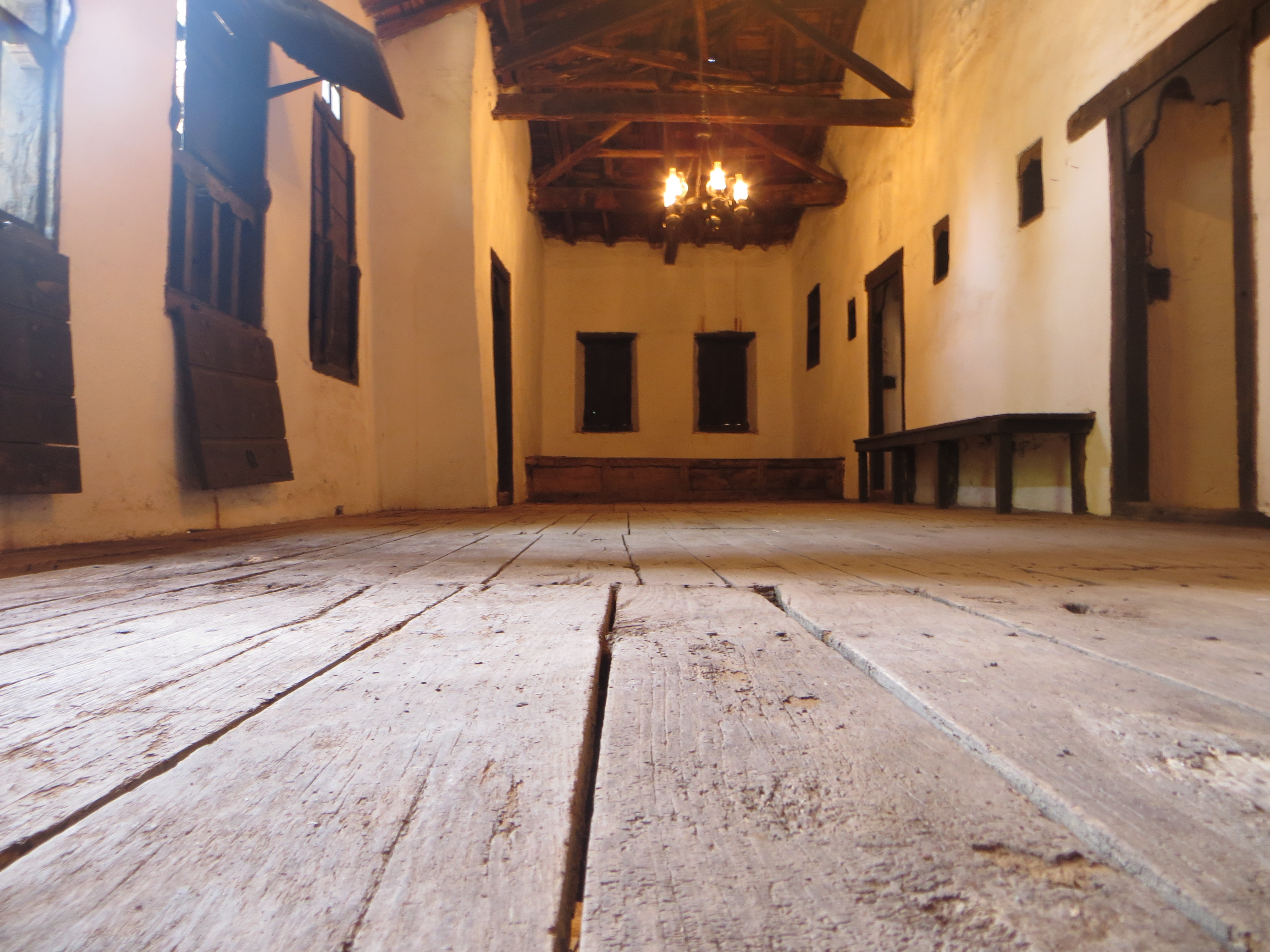
Ellinomoussio’s interior
In this institution Rigas Ferreos, the famous 18th century Greek hero and tutor, first attended school
In ‘Ellinomoussio’ many important scholars attended classes such as Rigas, Gazis, Konstandas, Phillipos Ioannou e.t.c. Most important tutors were monk Zacharias, K. Triandafillidis and K.Kassavetis who was Rigas’ fellow student.
Another quite important monument in Zagora is its Library which was established in 1762 originally as part of ‘Ellinomoussio’. Many scholars such as Kallinikos or Pringos contributed to its development with their donations. The Library has many rare publications from important publishers of the time like Aldos Manutios or Erasmus Schmidt. The oldest book is Gazis’s ‘Greek Grammar’ pub. by Manutios in 1495 while the oldest manuscript is ‘Four Gospels’ of the 10th cent. Today, the Library is in Agios Georgios square and has about 15.000 books.
Even today, Zagora remains financial and social prosperity which is due mostly to the existence of Zagora’s Agricultural Association. In the past it was silk. Today, is apple production. Zagora’s apples, known as ZAGORIN by their trademark, are exported everywhere in Europe and Middle East and are considered as the best in the world.
Nowadays Zagora’s trade
Finally, about development of tourism sector. Tourism hasn’t spoilt nature. Zagora is still a beautiful, picturesque village. Chorefto, Zagora’s port, is 8 km far from the village. It has a long, beautiful beach and tranquility which is not easily found elsewhere. Pouri is also a nice, small village near Zagora with a well-known three- level square and a magnificent view of the Aegean sea.



 Tasios Family